
New Delhi puts technology inside the BRICS agenda
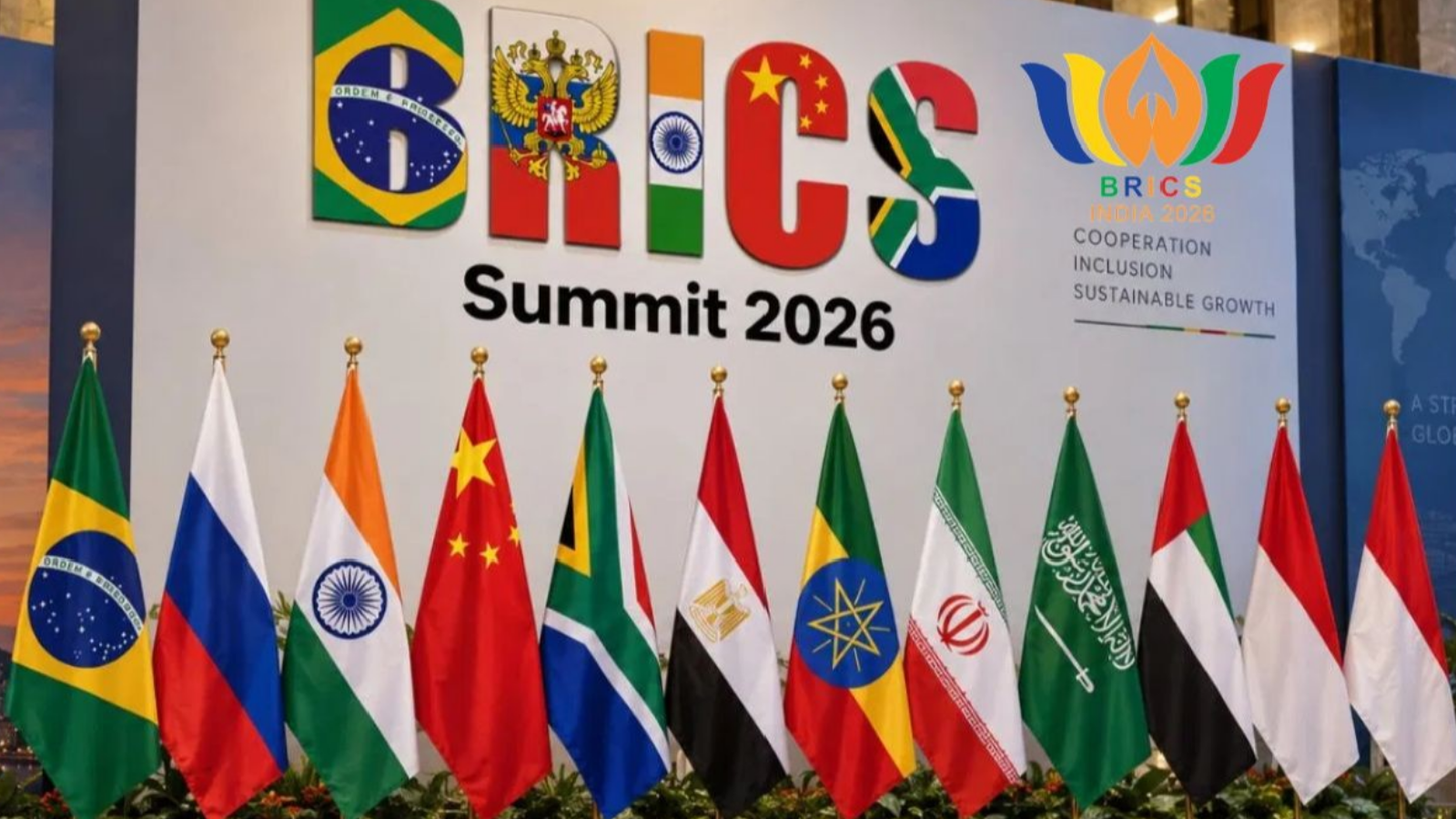
The 18th BRICS Leaders’ Summit is taking place in New Delhi on September 12 and 13, 2026, under India’s chairship. The summit’s broader theme is “Building for Resilience, Innovation, Cooperation and Sustainability”, but the technology implications are hard to miss: leaders are discussing digital infrastructure, artificial intelligence, cross-border payments, critical supply chains and the role of technology in the Global South.
AI is no longer a side conversation
The New Delhi Declaration gives artificial intelligence a clear place in the bloc’s cooperation agenda. The emphasis is on AI that is ethical, inclusive and secure and that can be adapted to the needs of developing economies. For technology companies, that matters because BRICS is increasingly a market for digital public infrastructure as well as a political grouping.
Digital public infrastructure gets a bigger role
India’s experience with digital public infrastructure has become one of the country’s strongest technology exports. The summit’s declaration supports work around a BRICS digital public infrastructure repository, which could create a way for member countries to exchange practical lessons on digital systems rather than treating infrastructure as a purely domestic issue.
Cross-border payments remain a major fintech opportunity
The summit also puts financial connectivity on the agenda. The New Delhi Declaration backs efforts to make cross-border payments faster and safer and supports greater use of national currencies for trade and investment. A BRICS payment task force is examining how national payment systems can work together. For fintech builders, interoperability may be more important than the idea of a single BRICS currency.
Technology and critical minerals are becoming strategic issues
Prime Minister Narendra Modi warned during the summit that geopolitical tensions, supply-chain disruption and the weaponisation of technology and critical minerals could affect global stability. That message connects technology policy to industrial policy. AI, electric vehicles, semiconductors and advanced manufacturing all depend on infrastructure and materials that can be exposed to geopolitical shocks.
A health-tech outcome also emerged
BRICS leaders agreed on cooperation around an integrated early-warning system for infectious diseases. The initiative is not a consumer technology launch, but it shows how digital infrastructure, health data and cross-border coordination are becoming part of resilience planning.
India-China engagement adds another technology layer
Prime Minister Narendra Modi and Chinese President Xi Jinping also met on the sidelines of the summit, with both sides expressing commitment to work towards a fair and mutually acceptable resolution of the boundary question. While the meeting is primarily geopolitical, any improvement in the relationship has implications for trade, supply chains, technology and manufacturing.
What the summit means for Indian technology companies
For Indian founders and technology businesses, the most useful signal from the summit is that digital infrastructure is being treated as an economic and geopolitical capability. Payments, AI, cloud systems, health technology, smart manufacturing and critical supply chains are increasingly connected. Companies that can build interoperable products for emerging markets may find a larger opportunity as BRICS members look for practical technology cooperation.
NewsTech view: execution will matter more than declarations
The summit creates a framework, not an automatic outcome. The real test will be whether proposed repositories, payment interoperability, AI cooperation and resilience initiatives become working systems that businesses and citizens can use. For India, the opportunity is to turn its experience in digital public infrastructure into products, standards and partnerships that travel beyond the domestic market.
Why the technology agenda matters
BRICS 2026 is increasingly a technology story because the group is discussing the infrastructure through which economies communicate, trade and move money. AI is one part of that conversation, but it sits alongside payment interoperability, digital public infrastructure, cybersecurity, cloud and supply-chain resilience. For India, hosting the summit creates an opportunity to connect its domestic digital public infrastructure experience with a broader international conversation.
Digital public infrastructure moves into the global conversation
India has spent years building digital systems around identity, payments and public-service delivery. At BRICS, the discussion is broader: how can participating economies exchange lessons and create interoperable systems without giving up national control? The answer will depend on common technical standards, trust frameworks and practical governance, not simply on signing a declaration.
The cross-border payments challenge
Cross-border payments are one of the clearest areas where technology policy becomes a business problem. International transactions can involve multiple intermediaries, different compliance regimes and settlement processes that add time and cost. BRICS countries have been exploring links between their fast-payment systems and central-bank digital currencies. Reuters reported that India has also been advocating stronger digital-currency and payment-system links, although political and technical hurdles remain.
AI is becoming an infrastructure discussion
The AI discussion at BRICS is not limited to consumer chatbots. Delegates are increasingly discussing compute, data, skills, open models, safety and access to the infrastructure needed to build AI capabilities. That matters for startups because the cost and availability of compute can influence which companies are able to experiment, train models and bring products to market.
Technology supply chains are part of the strategic debate
Prime Minister Narendra Modi has highlighted the risks created by supply-chain disruptions and the weaponisation of technology and critical minerals. For the technology industry, that means semiconductors, energy systems, data-centre infrastructure, rare materials and manufacturing capacity increasingly sit inside the same strategic conversation.
The startup opportunity inside a government agenda
One of the more practical opportunities is the possibility of translating policy priorities into startup markets. AI for education, digital payments, agricultural technology, cybersecurity, health systems, logistics and climate resilience all require companies that can turn broad policy goals into usable products. The quality of execution will decide whether that opportunity creates durable businesses.
India’s position in the larger technology map
India enters the conversation with advantages in software engineering, digital public infrastructure and a large domestic market. Its challenge is to convert those strengths into globally competitive intellectual property, products and infrastructure. BRICS can create a forum for that ambition, but companies still have to prove product-market fit and build reliable systems.
What this means for founders and technology companies
For founders, the summit is useful as a signal of where institutional demand may move next. Payments interoperability, AI governance, cybersecurity, supply-chain resilience and digital infrastructure are no longer isolated themes. They intersect with financial services, enterprise software, manufacturing and public-sector technology.
The business test comes after the summit
Declarations are only the first stage. The next indicators to watch are pilots, technical standards, cross-border integrations, procurement opportunities and private-sector partnerships. If the ideas discussed in New Delhi translate into working infrastructure, startups and enterprises will have a new set of markets to serve. If they remain only diplomatic language, the technology impact will be much smaller.
NewsTech take
The strongest takeaway from BRICS 2026 is that technology is now being discussed as economic infrastructure rather than as a separate industry. AI, payments, digital identity, cybersecurity and critical supply chains increasingly affect national resilience and business competitiveness at the same time. That is the technology story to watch after the headlines from New Delhi fade.
AI cooperation will depend on infrastructure as much as models
A regional AI conversation cannot stop at model announcements. Countries need compute capacity, data infrastructure, research talent, reliable connectivity and rules for responsible deployment. For startups, this matters because AI products are built on an infrastructure stack that includes chips, cloud services, storage and networks. Shared research, open technical standards and access to infrastructure could lower barriers for smaller teams, while stronger governance could help customers trust AI systems in sensitive areas.
Digital payments can become a bridge between markets
The cross-border payments discussion is especially relevant to businesses that trade across emerging markets. A payment system that settles faster and connects national rails more effectively can reduce friction for exporters, marketplaces, travel companies and financial institutions. The technology challenge is only half of the problem. Interoperability also requires compatible compliance rules, fraud controls, identity checks and settlement arrangements. The BRICS debate therefore sits at the intersection of engineering and financial regulation.
Why founders should watch policy signals
Startup founders rarely attend a summit to read declarations line by line, but policy signals can shape future markets. When governments prioritise AI, digital infrastructure, cyber resilience, agriculture technology or payment connectivity, those priorities can influence public procurement, enterprise demand and investment. The opportunity for founders is not to chase a headline. It is to identify a genuine customer problem that becomes more important because the underlying infrastructure is changing.
After New Delhi, execution becomes the story
The technology significance of BRICS 2026 will ultimately be measured by what happens after the summit. New standards, pilots, payment links, research collaborations, startup programmes and cross-border infrastructure projects are the indicators worth tracking. If those efforts move from diplomatic language to usable systems, the summit will have helped create a meaningful technology platform for the Global South. If not, the declarations will remain mostly symbolic. For NewsTech readers, that makes the implementation phase the most important chapter still to come.